Most AI tools generate code. GoDo generates structured metadata that a hardened runtime engine executes. Here's why that matters for regulated industries.
AI-assembled metadata vs. AI-generated code
These tools use AI to generate raw source code that must be executed directly.
GoDo's AI generates structured JSON metadata that describes the workflow. A TypeScript runtime engine — built on curated, compliance-aware components — executes it.
A sophisticated 3-pass LLM architecture that generates structured, auditable metadata
At no point does the system generate or execute arbitrary code. Every component is known, tested, and validated.
Curated, compliance-aware building blocks — not AI-invented code
Backed by 15+ years of operating compliance workflows in regulated industries. The GoDo Platform 2026 codebase is new — built from the ground up on Postgres with the lessons of those years in its architecture.
Built on a modern TypeScript runtime with mapped ActivityType enums (IMPORT, EVENT, APPROVAL, etc.) and curated Domain Patterns for common compliance workflows.
Every component in the library is hand-curated with audit log, encryption, and retention defaults baked in. The AI selects and assembles — it never invents new logic or hallucinates functions.
Why this matters: Unlike AI coding tools that can generate infinite variations of untested code, GoDo's AI can only select from a finite, validated library. This constraint is a feature, not a limitation - it's what makes the output auditable and compliance-ready.
Every action, logged and timestamped — on the same database transaction as the change
GoDo's audit trail today is a real, immutable record of every workflow action — backed by a Postgres trigger that physically prevents modification. Cryptographic hash-chain signatures are roadmap and will not be claimed as shipped until they are.
Application-layer enforcement today — database-layer isolation on the roadmap
Today, tenant isolation is enforced at the application layer through a centralized data-access layer. Database-level enforcement via RLS is on the near-term roadmap. We will not claim "complete" isolation until that ships.
Parallel execution, branching logic, and cross-process coordination
Launch multiple workflow branches simultaneously - perfect for due diligence processes where different teams work on different aspects in parallel.
Automatically wait for multiple parallel branches to complete before proceeding - essential for approval workflows requiring multiple stakeholders.
Dynamic routing based on data values, user roles, or external conditions - all visually represented and fully traceable.
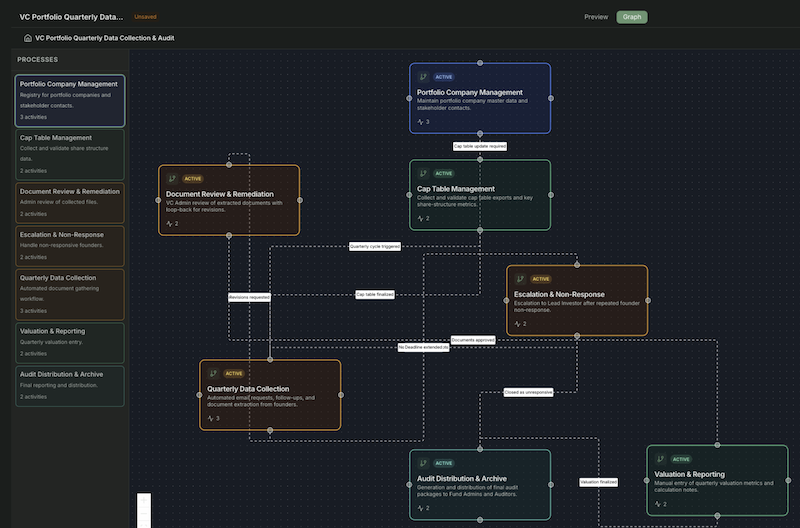
Cross-process coordination at the highest level - manage complex multi-workflow scenarios like startup intake flowing into due diligence and investment closing.
Advanced Capabilities: GoDo's branching and parallel workflow orchestration enables these advanced patterns at the highest level, making it suitable for the most complex compliance workflows in PE, VC, insurance, and healthcare operations.
As fast as vibe coding - before you need developers to harden it
| Stage | AI Coding Tools | GoDo Platform |
|---|---|---|
| Initial Generation | ~60 seconds Fast prototype |
~60 seconds Scaffold generation |
| Review & Refinement | Hours to days Code review, testing |
Minutes to hours Visual workflow editing |
| Hardening for Production | Weeks to months Security, error handling, audit trail |
Already built-in Pre-validated components |
| Compliance Documentation | Manual effort Reverse-engineer audit trail |
Automatic Built into architecture |
| Total Time to Production | Months Fast to prototype, slow to production |
Hours to days Production-ready from start |
The vibe coding scaffold generation operates in under 60 seconds. The difference is what happens next: with AI coding, you need developers to harden it. With GoDo, you're already production-ready.
What to actually expect when building on GoDo
Hours: Document collection, approval routing, status tracking - straightforward linear processes can be configured and deployed in a single working session.
1-3 Days: Multi-stakeholder workflows with conditional logic, parallel branches, and integration points may require iterative refinement in the visual builder.
Days to Weeks: Highly complex workflows with extensive branching, cross-process orchestration, and custom data bindings may need manual refinement if the AI's first pass isn't perfect.
The technical decisions that enable compliance at speed
Visual workflow graphs, not code. Your compliance officer can trace every decision. Your auditor can verify every step. No "trust the black box" required.
Because no arbitrary code is generated or executed, there are no SQL injection risks, no buffer overflows, no dependency vulnerabilities from AI hallucinations.
Every component is hand-curated with audit log, encryption, and retention defaults baked in. Workflows inherit those properties automatically.
Audit entries are written in the same Postgres transaction as the workflow change — they ship together or fail together. A Postgres trigger physically prevents UPDATE or DELETE on audit rows.
Every query routes through a centralized data-access layer that enforces tenant scope. Audit logs and workflow data are scoped per tenant. RLS-based database enforcement is on the roadmap.
Ops teams configure, deploy, and maintain workflows themselves. No IT queue. No developer bottleneck. No technical debt.
Run the entire stack on hardware you own — AI inference included
pnpm dev:sovereign routes all LLM calls to a local Ollama instance — zero cloud API calls.Who this matters for: Any regulated industry where data residency is a hard requirement — law firms (Rule 1.6), healthcare (HIPAA-adjacent workflows), finance (internal policy data that can't touch external AI). Sovereign mode was designed for the customer who cannot accept "your data stays private because we promise" and needs "your data stays private because the architecture makes it physically impossible to leave."
Most technical demos show you slides. We'll show you the actual metadata scaffold, the visual workflow builder, and the audit trail in real-time.
Book a Technical Deep-Dive →Bring your toughest compliance workflow. We'll build it together.